AI Video Ad Creative Testing: Build Useful Variations and Learn from Them
Organize creative hypotheses, change one variable and interpret campaign results carefully.
By the ClipMotion team · · 2,430 words · 12 min read
A ClipMotion brand guide written with AI assistance. Worked examples are hypothetical and do not represent measured customer results.
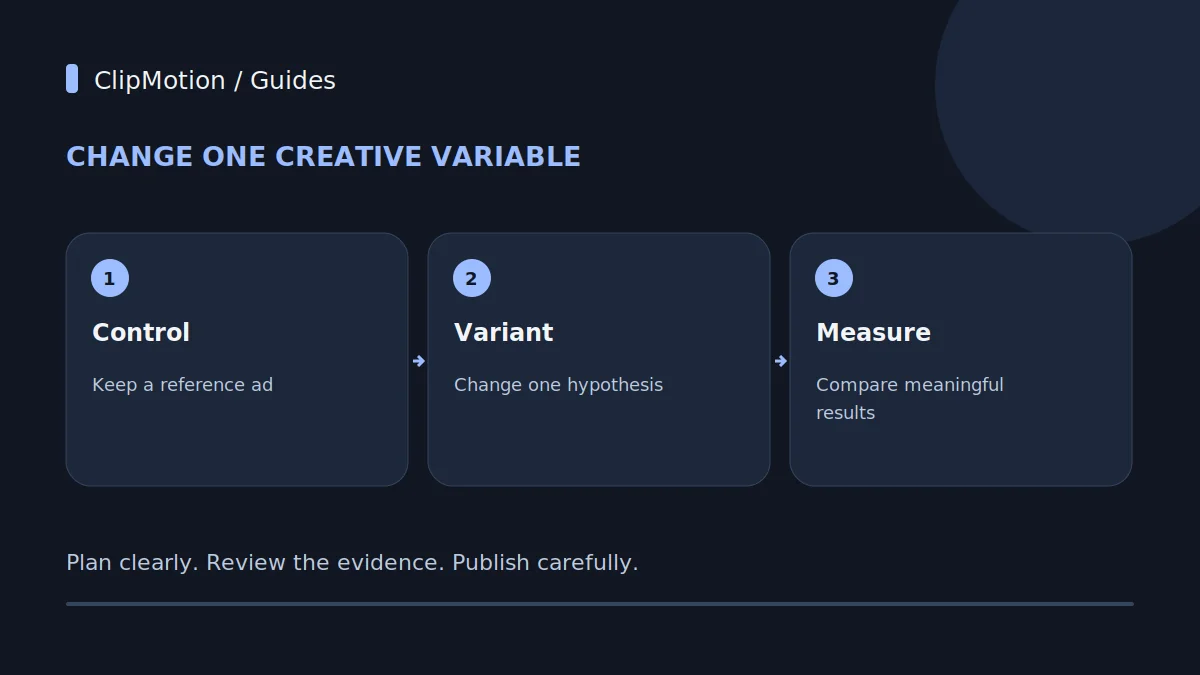
AI video ad creative testing is most effective when approached with a structured, hypothesis-driven methodology that isolates specific creative elements for evaluation, ensuring that observed performance differences can be directly attributed to the intended variation. By systematically generating diverse video ad variations using tools like ClipMotion, focusing on single-variable changes in hooks, offers, or visual styles, and then measuring their impact on qualified conversions rather than just views, brands can extract actionable insights to optimize their campaigns. This disciplined process, supported by a clear decision journal, transforms ad testing from a trial-and-error exercise into a strategic learning engine, driving continuous improvement in ad effectiveness and return on ad spend.
Formulating Clear Hypotheses for Ad Variations
Effective creative testing begins not with building variations, but with forming precise, testable hypotheses. A hypothesis acts as a prediction about how a specific creative change will impact ad performance, allowing you to learn from your tests rather than just observe. For our hypothetical product, a "portable reading light" with features like adjustable brightness, a flexible neck, and long battery life, we might start with broad assumptions. However, these need refinement. For instance, "People will buy the light if they see its features" is too vague. A better hypothesis isolates a single variable and predicts an outcome.
Consider these structured hypothesis examples:
- Hook Hypothesis: "Presenting the portable reading light as a solution for 'eye strain during late-night reading' in the first three seconds will generate a higher click-through rate (CTR) than a hook focusing on 'portability for travelers,' because the former addresses a more immediate and painful problem for a broader segment of readers."
- Offer Hypothesis: "An ad offering a '10% discount on first purchase' will lead to a higher qualified visit-to-signup rate than an ad offering 'free shipping,' because the perceived immediate value of a price reduction is greater for a lower-cost item like a reading light."
- Visual Style Hypothesis: "A visually warm, cozy aesthetic featuring the reading light in a bedroom setting will result in a higher engagement rate (e.g., watch time) compared to a brightly lit, professional product shot, because the cozy scene evokes emotional comfort, aligning with the act of reading."
Defining Your "Portable Reading Light" Product and Audience
To build effective ad variations, a deep understanding of your product and its target audience is paramount. Our hypothetical "portable reading light" isn't just a gadget; it's a solution. It offers adjustable brightness (warm to cool tones), a flexible silicone neck, a clip-on design, and a 50-hour battery life on its lowest setting. Its primary benefit is providing comfortable, customizable illumination for reading anywhere, anytime, without disturbing others.
Our core audience for this product might include:
- Students: Needing discreet light for late-night study sessions in shared dorms or libraries.
- Avid Readers: Those who enjoy reading in bed, on commutes, or while traveling, valuing comfort and portability.
- Parents: Looking for a gentle light for bedtime stories that won't disrupt a sleeping child.
- Seniors: Requiring clear, adjustable lighting for reading small print, prioritizing eye comfort.
- Travelers/Campers: Seeking a durable, long-lasting light source that's easy to pack.
Crafting Diverse Hooks: Attention-Grabbers and Problem Statements
The hook, typically the first 3-5 seconds of your video ad, is critical for capturing attention and communicating immediate value. It's where you either earn a watch or get scrolled past. When testing hooks for our portable reading light, we must consider both direct and indirect approaches, focusing on varying the "camera confounds" – essentially, how the product is presented visually and contextually – and the core messaging.
Let's develop a few hypothetical hook variations:
- Problem-Solution Hook (Visual Focus: Tired Eyes):
- Visual: Close-up of someone squinting at a book in dim light, followed by an immediate cut to the portable reading light being clipped on, illuminating the page perfectly. LTX 2.5 would be directed to generate clips showing this contrast.
2.
Exploring Offers and Calls-to-Action: Incentives and Urgency
The offer and call-to-action (CTA) are critical for converting interest into action. For our portable reading light, these elements need to be clear, compelling, and strategically varied for testing. An effective offer provides an incentive, while a strong CTA directs the user on what to do next. When varying these, we're essentially testing different "offer confounds" – how the perceived value proposition impacts the user's decision to click or convert.
Here are hypothetical variations for testing:
- Discount Offer + Direct CTA:
- Offer: "Get 15% Off Your First Portable Reading Light."
- CTA: "Shop Now & Save"
- Context: This is a classic direct discount, appealing to price-sensitive buyers. It aims for immediate gratification.
2.
3.
When incorporating these into your ClipMotion project, Remotion is crucial for ensuring the exact text of the offer and CTA is precisely positioned and legible in the final composition.
Visual Composition and Camera Angles: Directing the AI's Eye
The visual presentation of your product, encompassing composition and camera angles, significantly influences how an ad is perceived. These "camera confounds" can subtly (or overtly) shift the focus, emotion, and functionality conveyed. When using ClipMotion, you are directing LTX 2.5 to generate visual scenes, and understanding how to prompt for specific camera angles and compositions is vital for effective testing.
Let's consider variations for our portable reading light:
- Close-Up Detail Shot (Macro/Product Feature Focus):
- Description: A tight, focused shot on a specific feature, like the flexible neck bending, the clip mechanism, or the subtle glow of the eye-care filter. The background should be blurred or minimal to emphasize the feature.
2.
3.
When reviewing the clips generated by LTX 2.5, assess if the intended composition and angle are accurately represented.
Building Consistent Test Groups: Audience, Budget, and Attribution
For ad testing to yield truly useful insights, the environment in which ads are served must be as controlled as possible. This means establishing comparable audience segments, allocating equivalent budgets, and understanding the limitations of attribution. Without this consistency, observed performance differences might be due to external factors rather than the creative variations themselves.
Comparable Audience Segmentation: To isolate the impact of your creative, each ad variation must be shown to an identical or highly similar audience segment. This means avoiding testing Ad A on "avid readers" and Ad B on "students" simultaneously if your goal is to compare ad creatives.
Equivalent Budget Allocation: Budget allocation is another critical factor.
Understanding Attribution Limits: It's crucial to acknowledge the inherent limitations of attribution models.
Leveraging ClipMotion for Efficient Variation Generation
ClipMotion is designed to streamline the creation of diverse video ad variations, making systematic testing feasible. Its structured workflow allows you to control key creative elements effectively. Here's how to leverage it for our portable reading light ad variations:
- Template Selection: Start by choosing a ClipMotion template that aligns with the general style and duration you envision for your ad. Templates provide a structural foundation, but the content within them is entirely customizable.
- Product References and Messaging: Upload high-quality images of the portable reading light or use product link analysis to import visuals. When using image uploads, be mindful that some online stores may block direct import, requiring manual uploads.
3.
4.
5.
6.
By systematically using ClipMotion's features, you can rapidly produce high-quality, targeted video ad variations for your portable reading light, ready for testing and optimization.
Worked Example 1: Testing a Feature-Benefit Hypothesis
Let's apply our methodology to a specific hypothesis for the portable reading light: "An ad emphasizing the '50-hour battery life' and its benefit for 'extended travel' will outperform an ad highlighting 'adjustable brightness' for 'eye comfort' among a general travel enthusiast audience, due to the higher perceived utility of long-term independence during journeys."
Hypothesis: Ad A (Battery Life/Travel Benefit) will have a higher click-through rate to the product page than Ad B (Adjustable Brightness/Eye Comfort) for the target audience of travel enthusiasts.
Test Design:
- Product: Portable Reading Light (all features remain consistent in the product itself).
- Audience: Travel enthusiasts (segmented identically for both ad sets).
- Platform/Budget: Equal budget distribution across both ads.
- Duration: 7 days.
Ad A: Focus on Battery Life & Travel (The "Traveler's Companion") 1.
Worked Example 2: Testing an Emotional Appeal Hypothesis
Let's explore a second hypothesis for our portable reading light, focusing on emotional resonance: "An ad evoking the emotion of 'peaceful escape' through serene visuals and soft music will generate a higher watch-through rate and a greater number of qualified visits to the product page than an ad emphasizing 'convenience and versatility' with quick cuts and energetic music, for an audience valuing personal relaxation and wellness."
Hypothesis: Ad A (Peaceful Escape) will achieve a higher average watch-through rate and a greater percentage of viewers clicking through to the product page (qualified visits) than Ad B (Convenience & Versatility), among individuals interested in relaxation and self-care.
Test Design:
- Product: Portable Reading Light.
- Audience: Individuals interested in relaxation, mindfulness, and self-care.
Ad A: Focus on Peaceful Escape (The "Serenity Seeker") 1.
Interpreting Results: Beyond Views to Qualified Conversions
The true measure of a video ad's success goes far beyond simply accumulating views. While views are a basic indicator of reach, they don't necessarily equate to meaningful engagement or business outcomes. The crucial distinction lies between a mere view and a qualified visit or signup. For our portable reading light, we're not just seeking eyeballs; we're seeking potential customers.
Understanding "View" vs. "Qualified Visit/Signup":
- View: An impression of your video ad, often defined by platforms as watching a few seconds (e.g., 3 seconds) or a certain percentage of the video. It tells you your ad was seen.
When analyzing your ad performance for the portable reading light, prioritize these metrics:
1.
Example Interpretation for the Portable Reading Light: If Ad A (Battery Life/Travel) generated 10,000 views and 500 clicks (5% CTR), leading to 30 purchases.
The Creative Decision Journal: Documenting Insights and Iterations
A creative decision journal is an indispensable tool for systematic learning in ad testing. It's a structured record of your hypotheses, test designs, outcomes, and subsequent actions. Without it, insights from prior tests are easily lost, leading to repetitive mistakes or missed opportunities for compounding success. For our portable reading light brand, this journal becomes the central repository for creative intelligence.
What to Include in Your Decision Journal:
- Test ID & Date: A unique identifier and the start/end dates of the test.
- Hypothesis: Clearly state the specific, testable hypothesis. (e.g., "We hypothesize that an ad featuring the light's flexible neck will generate a higher CTR than one focusing on its clip-on design, because the former demonstrates dynamic utility.")
3.
Final Checklist for Effective AI Video Ad Testing
To ensure your AI video ad testing for the portable reading light is rigorous and yields actionable insights, follow this concise checklist:
- Hypothesis Formulated: Each test starts with a clear, specific, and measurable hypothesis that isolates a single creative variable.
- Single Variable Change: Only one core element (hook, offer, visual style, CTA, etc.) is varied between ad groups, keeping all other elements constant.
- Comparable Audience Segments: All ad variations are targeted to identical audience segments to prevent audience confounds.
- Equal Budget Allocation: Each ad variation receives an identical budget for the duration of the test, ensuring fair exposure.
- ClipMotion Workflow Utilized:
- Templates selected and customized.
- Exact product references and messages supplied.
- Scene workflow planned for each clip.
- LTX 2.5 clips generated with clear prompts for desired visuals/actions.
- Visual fidelity of LTX 2.5 clips thoroughly reviewed and refined as needed.
- Remotion used for precise text, logo, and CTA overlays.
- Projects saved for easy duplication and iteration.
- Authentic Footage Considered: For highly nuanced emotions or complex demonstrations, authentic photographs, screen recordings, or footage are used if AI generation (LTX 2.5) cannot achieve the desired fidelity or realism.
- Acceptance Criteria Met: Each ad variant meets predefined quality standards for visual clarity, messaging accuracy, and brand representation before launch.
- Metrics Defined: Clear primary and secondary performance metrics (CTR, Qualified Visit Rate, Conversion Rate) are established before launching the test.
- Attribution Limitations Understood: Results are interpreted with an awareness that attribution models provide directional insights, not absolute truths about the customer journey.
- Decision Journal Maintained: All hypotheses, test designs, results, analyses, and next steps are meticulously documented in a creative decision journal.
- Focus on Qualified Conversions: Success is measured by actions indicating genuine interest or conversion (e.g., add-to-cart, purchase, signup), not just passive views.
- No Fabricated Claims: All claims, examples, and product specifications in ad creatives are factual and verifiable for the hypothetical portable reading light; no invented statistics or testimonials.
- Continuous Iteration Planned: Testing is an ongoing process; insights from one test inform the hypotheses for the next, fostering continuous improvement.
Frequently Asked Questions about AI Video Ad Testing
Q1: How many variations should I test simultaneously? A1: For robust learning, it's generally best to test a small number of variations at a time, ideally isolating one core variable between each ad group (e.g., two or three variations of a hook, or two distinct offers). Testing too many simultaneously can dilute your budget, extend the test duration required to achieve statistical significance, and make it difficult to pinpoint which specific change drove the performance difference. For our portable reading light, you might test "Ad A: Feature A" vs.
Q2: How long should I run an AI video ad test? A2: The duration depends on your budget, audience size, and conversion volume. A common guideline is to run tests until each ad creative has accumulated sufficient data for statistical significance, or for at least 7 to 14 days to account for weekly audience behavior cycles.
Q3: What if ClipMotion's LTX 2.5 generates visuals that aren't exactly what I envisioned? A3: Visual fidelity from LTX 2.5 is never guaranteed, and this is a common part of working with AI generation. If the initial clips don't match your vision for your portable reading light ad, review your prompt for clarity and specificity. Try refining descriptive terms for camera angles, lighting, environment, or actions. Providing specific image uploads as references can also help guide LTX 2.5 more effectively.
Q4: Can I test different ad formats or lengths with AI video tools? A4: Yes, you can test different video ad lengths or formats (e.g., short, punchy 15-second ads versus more detailed 30-second ads) by creating distinct projects within ClipMotion. Each ad project would then be set up with its own scene workflow, potentially using different templates to match the desired length or format. However, when testing length or format, this becomes the primary variable under examination.
Ready to transform your creative testing strategy? Start building your first hypothesis-driven video ad variations for your portable reading light with ClipMotion today and begin learning what truly resonates with your audience.