Choosing Music for Product Video Ads: Mood, Clarity and Rights
Choose sound that supports the message and review licensing, voice clarity and the final export.
By the ClipMotion team · · 2,426 words · 12 min read
A ClipMotion brand guide written with AI assistance. Worked examples are hypothetical and do not represent measured customer results.
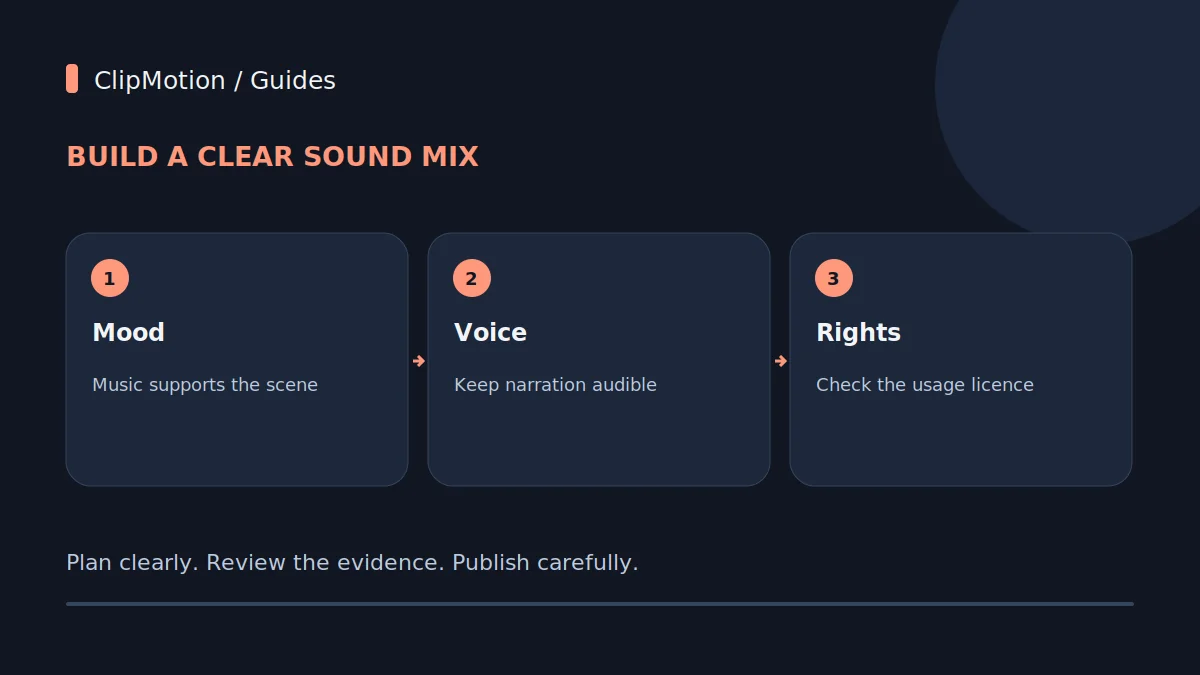
Choosing the right music for product video ads is a critical step that significantly influences viewer perception and message retention. Effective music selection involves a careful balance of aligning the audio mood with your brand and product, ensuring absolute clarity for any accompanying voiceover or on-screen text, and meticulously verifying all licensing rights for your intended distribution channels. The goal is to create an immersive and persuasive experience where music enhances, rather than detracts from, your product’s story, making a lasting emotional connection without legal complications.
The Foundational Role of Music in Product Video Ads
Music in product video advertising is far more than mere background noise; it is a powerful, non-verbal communicator that shapes emotional responses, dictates pacing, and reinforces brand identity. A well-chosen soundtrack can evoke feelings of trust, excitement, serenity, or sophistication, directly influencing how a viewer perceives your product and brand. For a minimalist home fragrance diffuser, for instance, the music needs to immediately convey a sense of calm, elegance, and purity, setting an expectation of tranquility and refined living. It's the subtle emotional cues within the music that can transform a simple product demonstration into an aspirational experience. Without this deliberate choice, even the most beautifully shot visuals can fall flat, failing to resonate with the target audience on a deeper level. The music becomes the emotional glue that binds the visual narrative together, guiding the viewer through the story you want to tell about your product.
Defining Your Ad's Emotional Landscape
Before even considering specific tracks, clearly define the emotional landscape you want your ad to inhabit. This involves a deep understanding of your target audience, the core benefits of your product, and your brand's overarching personality. For our hypothetical minimalist home fragrance diffuser, key emotions might include serenity, peace, sophistication, cleanliness, and a touch of modern luxury. Brainstorm a list of adjectives that describe both your product and the desired feeling you want viewers to experience. Is it "calming" or "invigorating"? "Elegant" or "playful"? "Natural" or "high-tech"? These descriptors will serve as your compass when navigating music libraries. A mismatch, such as using an energetic, upbeat pop track for a product designed to promote relaxation, will create cognitive dissonance and undermine your message. The music should feel like an organic extension of the visual narrative, instantly communicating the product's essence before a single word is read or spoken.
The Pulse and Pacing: Guiding Viewer Attention
The tempo and rhythm of your chosen music are critical in dictating the overall pace of your video ad and subtly guiding viewer attention. A slow, deliberate tempo, often characterized by sustained notes and gentle progressions, naturally encourages a feeling of calm and reflection, perfectly suited for our minimalist home fragrance diffuser. This allows viewers to absorb the serene visuals and appreciate the product's design and function without feeling rushed. Conversely, a faster tempo with a more pronounced beat can inject energy and excitement, suitable for products that emphasize speed, innovation, or an active lifestyle.
Consider how the music's energy aligns with your visual transitions and text reveals. For a tranquil diffuser ad, a smooth, flowing musical progression should accompany slow pans or gentle fades between scenes.
Transition Cues and Silence: Strategic Audio Storytelling
Music isn't just about continuous sound; it's also about strategic use of its absence or subtle shifts to enhance storytelling. Music can serve as a powerful transition cue, signaling a shift in scene, a change in focus, or the introduction of a new benefit. A slight increase in intensity, a brief melodic phrase that resolves, or even a momentary pause can effectively bridge visual segments. For our minimalist diffuser, imagine a scene transitioning from a busy workday to a calm evening at home. A gentle musical motif could play as the scene shifts, smoothly guiding the viewer into the new environment the diffuser helps create.
Equally potent is the strategic use of silence. A brief, well-placed moment of silence, or a significant reduction in musical complexity, can dramatically emphasize a particular visual or a piece of on-screen text.
Clarity First: Ensuring Your Message Isn't Lost
The primary goal of a product video ad is to communicate effectively. Music, while essential for mood, must never overshadow your core message. Whether you have a voiceover, on-screen text, or crucial visual details, the audio mix must prioritize their clarity. This means the music should almost always function as background support, not as the dominant audio element. Volume levels are paramount; the music should be audible enough to set the tone but subdued enough that any spoken words are perfectly intelligible without effort. If your ad relies heavily on on-screen text, ensure the music isn't so busy or rhythmically complex that it distracts from reading.
Avoid tracks with prominent, unpredictable melodic lines or percussive elements that might compete with the rhythm of your text reveals or the natural flow of a voiceover.
The Practicalities of Device Listening and Sound Environments
The reality of modern media consumption means your product video ad will be viewed across a vast array of devices and listening environments. What sounds perfect on studio monitors might be muffled on a smartphone speaker, tinny through cheap earbuds, or lost in a noisy public space. Therefore, it's crucial to consider these playback variations during the music selection and mixing process. A track with very deep bass frequencies might be inaudible on smaller speakers, while overly bright or harsh high frequencies can become fatiguing on headphones.
Always test your final video on a variety of devices: a good pair of headphones, a typical smartphone speaker, a tablet, and if possible, a laptop and a TV. Pay attention to how the music interacts with other audio elements (like voiceovers) and how clear your message remains in each scenario. Furthermore, acknowledge the prevalence of silent autoplay on social media platforms.
Navigating Music Licensing: Scope, Territory, and Duration
Music licensing is a non-negotiable aspect of using audio in product video ads, and getting it wrong can lead to costly legal repercussions or forced ad removal. Simply put, you cannot use copyrighted music without explicit permission from the rights holders. "Royalty-free" is a common term, but it doesn't mean "free to use without any rules." It typically means you pay a one-time fee for specific usage rights, but these rights have limitations.
When acquiring music, meticulously review the license agreement for several key parameters:
- Scope of Use: Does it cover social media platforms? Is it valid for paid advertising campaigns (which often require broader rights than organic posts)?
Stock music libraries are a common source, offering various license tiers. Always choose the license that explicitly covers "commercial use" and "paid advertising" for your specific distribution channels. Never assume a general "web use" license extends to paid campaigns.
Step-by-Step Decision Making for Music Selection
A structured approach to music selection ensures you land on the perfect track without unnecessary backtracking.
- Define Ad Objective & Mood: Revisit your ad's core purpose. Is it to build brand awareness, drive sales, or introduce a new product? What specific emotions (e.g., calm, sophisticated, fresh for the diffuser) do you want to evoke?
- Brainstorm Keywords for Music: Translate your mood adjectives into musical terms. For the diffuser, this might be "ambient," "minimalist piano," "soft strings," "meditative," "calm," "organic," or "clean."
- Search Music Libraries: Utilize reputable stock music libraries (or consider custom composition for larger budgets). Input your keywords and listen to samples. Focus on tracks that align with your desired tempo and instrumentation.
- Audition Tracks Against Visuals: This is crucial.
Worked Hypothetical Example 1: The Serene Diffuser Launch
Scenario: We are launching a new high-end, minimalist home fragrance diffuser designed to create a tranquil atmosphere in modern living spaces. Our target audience is busy professionals seeking moments of calm and self-care. The ad aims to position the diffuser as an essential element of a serene home environment.
Desired Mood: Calm, sophisticated, peaceful, luxurious, subtle.
Music Choice Process:
- Keywords: "Ambient," "minimalist piano," "slow strings," "meditative," "elegant instrumental."
- Search & Selection: We search libraries for tracks featuring gentle piano melodies with soft, sustained string pads, avoiding prominent beats or complex arrangements. We find a piece with a very slow tempo (around 60-70 BPM) that has a spacious, airy feel. Its dynamic range is subtle, allowing it to sit comfortably in the background. 3.
Worked Hypothetical Example 2: The Energizing Diffuser Refill
Scenario: We are promoting a new line of invigorating, citrus-scented refills for the same minimalist diffuser. This ad targets individuals looking for a natural energy boost and a fresh ambiance, perhaps for a home office or kitchen. The ad needs to convey freshness, natural vitality, and a subtle uplift.
Desired Mood: Fresh, uplifting, natural, bright, clean, gentle energy.
Music Choice Process:
- Keywords: "Light acoustic," "uplifting instrumental," "natural energy," "subtle percussive," "bright folk."
- Search & Selection: We look for tracks featuring light acoustic guitar melodies, perhaps with a subtle, non-intrusive shaker or tambourine for a touch of rhythm, and occasional bright, airy synth pads. The tempo is moderate (around 90-110 BPM), suggesting gentle movement rather than intense activity. We specifically avoid anything too electronic or overly "busy."
3.
Common Mistakes and Their Fixes
Even with careful planning, pitfalls in music selection can occur. Being aware of these common mistakes and their fixes can save significant time and resources.
Mistake 1: Music Overpowering the Message.
- Symptom: Viewers struggle to hear voiceovers, read text, or focus on key visuals because the music is too loud or too complex.
- Fix: Always mix music at a lower volume than dialogue or primary audio. Choose simpler tracks with fewer competing elements. Use EQ to carve out frequencies where voices reside, or select instrumental tracks with sparse arrangements. Test extensively on various devices.
Mistake 2: Inconsistent Mood or Brand Mismatch.
- Symptom: The music evokes a different feeling than the product or brand intends, leading to confusion or a disconnect. For our diffuser, this would be an overly aggressive or playful track.
- Fix: Re-evaluate your ad's core objective and emotional goals. Go back to your keyword brainstorming.
Mistake 3: Licensing Oversight or Misinterpretation.
- Symptom: Using music without proper rights for paid advertising, leading to takedowns, legal notices, or unexpected fees.
Acceptance Criteria for Your Final Audio Mix
Before your product video ad goes live, evaluate its audio component against a clear set of criteria. This final check ensures your music selection and mix are not just good, but effective.
- Message Clarity is Paramount: Can every word of a voiceover be easily understood? Is on-screen text legible without being overshadowed by the music? If there's any ambiguity, the music is too loud or too complex.
- Mood is Consistently Supported: Does the music consistently reinforce the intended emotion and brand identity from start to finish? There should be no jarring shifts or moments where the music feels out of place with the visuals or product message. For our minimalist diffuser, the feeling of calm and sophistication must be unbroken.
- Transitions Feel Natural: Does the music smoothly guide the viewer through scene changes and narrative beats?
Concise Final Checklist
- Mood Alignment: Does the music perfectly match the desired emotion and brand personality?
- Message Clarity: Is all dialogue and on-screen text easily understood and prominent?
- Pacing Match: Does the music's tempo and rhythm complement the visual flow of the ad?
- Transition Effectiveness: Does the music aid scene transitions and highlight key moments?
- Device Playback: Has the audio been tested and optimized for various listening environments and devices?
- Licensing Secured: Is the music fully licensed for all intended commercial uses, territories, and durations?
- No Distractions: Are there any elements in the music that detract from the product or message?
- Volume Balance: Is the music level appropriate as background, never overpowering primary audio?
- Brand Consistency: Does the music reinforce the overall brand image and values?
Frequently Asked Questions
Q1: How much should I budget for music in my product video ads? The budget for music can vary significantly. For small businesses or limited campaigns, royalty-free music from stock libraries can range from $20 to $200 per track, depending on the license scope. Larger brands with more extensive campaigns or specific creative needs might invest in custom compositions, which can cost anywhere from a few hundred to several thousand dollars. The key is to view it as an investment in your brand's perception and legal security, ensuring you allocate enough to secure appropriate commercial licenses for your planned distribution.
Q2: Can I use popular songs in my product video ads to gain more attention? Generally, no, unless you have a very substantial budget and legal team. Licensing popular commercial songs for advertising is extremely complex and expensive, often costing tens of thousands to hundreds of thousands of dollars per song, per campaign. It involves negotiating with multiple rights holders (publishers and record labels). For the vast majority of brands, especially small to medium-sized businesses, this is not a viable option. It's far more practical and cost-effective to use music specifically licensed for commercial advertising from stock libraries or to commission original pieces.
Q3: What if my product video ad is very short, like 15 seconds? Does music still matter as much? Absolutely. Even in a very short ad, music plays a crucial role in setting the tone, grabbing attention, and conveying emotion quickly. A well-chosen 15-second music loop or snippet can instantly establish the mood for your minimalist home fragrance diffuser, making those few seconds more impactful. The challenge with shorter ads is finding music that can deliver its emotional punch rapidly without sounding abrupt or incomplete. Often, a carefully selected instrumental piece with a clear beginning and end (or a seamless loop) is most effective.
Q4: Should I use sound effects in addition to music in my product video ads? Sound effects can be a powerful complement to music, adding realism and impact. For instance, a subtle "whoosh" as the diffuser mist appears, or a gentle "click" as a button is pressed, can enhance the viewer's engagement. However, use them sparingly and intentionally. Overuse of sound effects can make an ad feel cluttered, distracting from the main message, or even cheesy. When used, ensure sound effects are mixed appropriately, sitting beneath the music and voiceover, and only highlighting key product interactions or visual cues. The focus should remain on the music for emotional tone and the primary audio for message clarity.
Ready to bring your product visuals to life? Start your next video project with ClipMotion today and focus on perfecting your visual story, knowing you can then expertly layer your chosen soundtrack.